















Epic launched its Epic Games Store back in 2018 in aggressive fashion, paying out millions of dollars to secure exclusives in a bid to steer PC gamers away from Valve’s all-encompassing Steam. Six years later, Steam effortlessly maintains its vice-like grip on the PC gamer consciousness.
So, how is the Epic Games Store actually doing? How has its strategy changed over the years? Can it ever topple Valve when it comes to PC gaming market share? Are Epic Games Store exclusives actually dead? And aren’t people just logging on to grab a free game as part of Epic’s compelling giveaways, before heading straight back to Steam?
It was with all this in mind that I interviewed Steve Allison, VP and GM of the Epic Games Store, about the store's 2025 and what's coming in 2026. Our chat began with a runthrough of last year's performance, which Allison pointed to throughout. The headline here is that $400 million was spent by players on third-party PC games in the Epic Games Store in 2025, up an impressive 57%. This figure was down about 18% last year, which, Allison said, means 2025 saw a “profound and positive change.” In total, $1.16 billion was spent by PC players on the Epic Games Store, up 6%. The Epic Games Store hit 78 million Monthly Average Users (MAUs) in December 2025, an all-time record. But the 67 million average MAU is down 1%, and the 31 million average DAU is down 2%.
Allison said Epic had noticed something happening on Steam when it gave a game away for free. As you’d expect, concurrent user numbers rise for a game on the Epic Games Store when it’s part of a free giveaway (over 77% of the 100 games given away for free last year set all-time peak concurrent users records on the Epic Games Store on PC). But the giveaways also cause a concurrent player spike for the game on Steam, of around 40%. Allison puts this down to Steam players who perhaps already have the game in their library and see coverage of it online because it’s gone free on the Epic Games Store, and their friends are talking about it, so they reinstall and dip back in. Sometimes they just buy it on Steam outright.
But Epic faces an uphill battle here, mostly because the Epic Games Store itself just isn’t as good to use as Steam for a whole bunch of reasons. To combat this, Epic is rebuilding the store on PC so the launcher is faster and doesn’t use as many memory resources. “It should feel fast and snappy and just be what you expect, frankly,” Allison said. The new and improved Epic Games Store should ship by June.
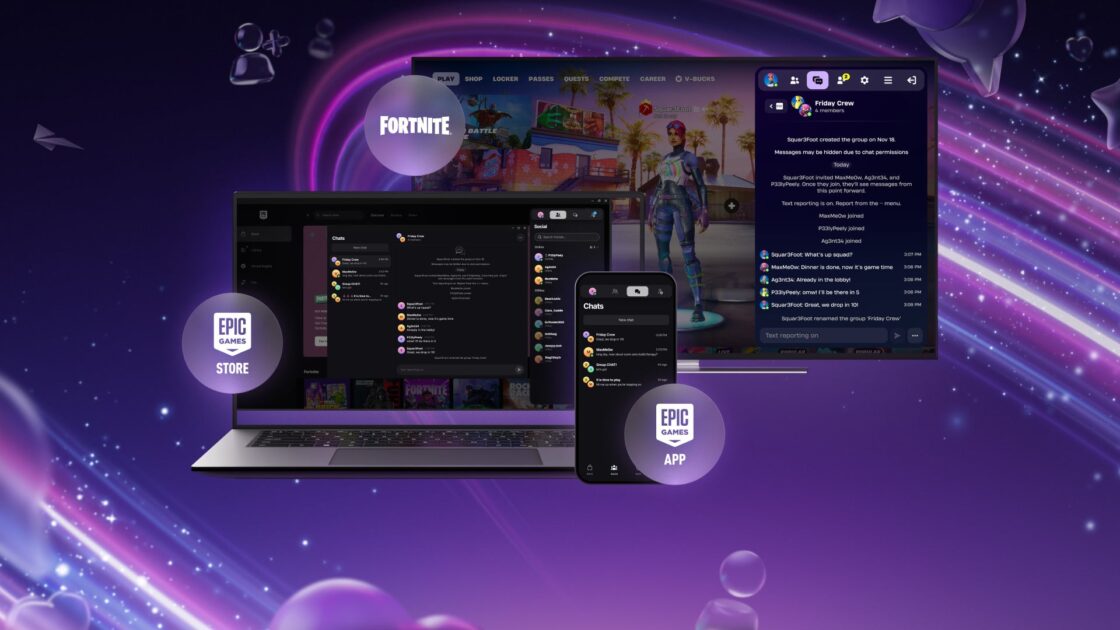
Epic’s vision for the Epic Games Store — and its point of difference with Steam — is that it’s a multiplatform store. That means one store connected across PC, Mac, iOS, and Android, and even other games. A big part of this is voice and text for parties independent of games, a bit like the console experience, but on PC and mobile. As most PC gamers know, community is pretty much non-existent on the Epic Games Store, and Allison acknowledged that. Forums are coming to the store, which sounds basic but has been in the works for some time. Expect Epic to make some noise about forums in the next few weeks.
And then there’s Fortnite. The battle royale behemoth. The everything game. Fortnite is key to this Epic Games Store push. It plans to use Fortnite to convince PC gamers to get their games from the Epic Games Store rather than Steam. To do that, it will tap into the marketing power of Fortnite, offering a Fortnite gift (a Fortnite cosmetic along with a matching character avatar for their Epic account profile) with a purchase of a game. Upcoming partners include Capcom, miHoYo, Pearl Abyss (Crimson Desert), S-Game, MintRocket, and Kakao Games, as the first to participate. Allison expects this to have a significant impact on sales.
After running through the stats, I asked Allison some questions on the details, some recent Epic Games Store controversies (Alan Wake 2, for example!), and about the master plan. Here’s the Q&A in full:
IGN: The perception online is that most of your MAUs are using the store to launch Fortnite, but you are suggesting that the stats counter that perception. But how exactly so?
Steve Allison: Our average monthly active users on third-party exceeds our average monthly active users on Fortnite. Now a lot of those users — it depends on how you define monthly active users — but in terms of player hours, yes, you're right. It's kind of 60, 66, 33 or 65, 35. But in terms of MAU, shopping, looking at stuff, maybe making transactions for free games or whatever, the MAU is flipped in the other direction. So we need to increase conversion through all the work that we're doing. That's what this is all about.
IGN: Similarly there is that perception online that people love your free games program, they dip in to grab the free games and leave. You must've seen this perception online. Are you seeing that shifting? Is there anything in the stats that suggests that?
Steve Allison: I think the answer is, not entirely true, right? The average conversion rate for a new player that's acquired through the free games program is about 16-25%. Depends, but no less than 16% over time. It's a pretty high conversion rate for scale. So that's one fact. The other is, you got to go back to that 35% of player hours coming from games using their own IAP (their own payment solutions for in-app purchases). We know anecdotally talking with Riot, talking with EA, the relationship on that spend is with the developer or the publisher. We don't see it and they're spending with them relatively at the expected rate that they would assume. So there's more commerce coming through the store than that argument would imply.
IGN: This touches on something the Larian publishing director was talking about on social media recently, which is that giving everyone everything for free might bump numbers but doesn't create a viable storefront from which to sell premium experiences. And I think that's his point, the conversion not just to play but to pay for new games. But you are suggesting that perhaps isn't the case?
Steve Allison: It's not the case. He was trying to frame Alan Wake in that context and it's just not true. Alan Wake sold really well and Remedy's statement there was on… we didn't talk to Remedy about it. They did that on their own to make sure that the world knew that wasn't true. Now, from a market share standpoint, we see some volatility there. So sometimes it'll be as small as a percent or two, and sometimes it'll be 25 up to 40% in some cases. So what we need to do is establish consistency and eliminate volatility. So it's really important for me that we get to… if we get to 20, 25, 30% of share predictably on all simultaneous ships, we will be $2 billion in third-party and that, including the people using IAP, right, so it'd be more. So our goal is really to be consistent. And so doing all the player work that's expected of us is going to drive conversion. And just in context of this conversation, that's one of the biggest things we need to do in order to create that consistency.
IGN: Bringing up Alan Wake, one of the things that isn't in your post is exclusives. Alan Wake too was a genuine exclusive. Are you still in this game? Are they still valuable for you? Is this something we're still going to see moving forward or do you take the position that actually there are better ways for you to operate the store than to have genuine exclusives in the way that Alan Wake 2 was?
Steve Allison: A couple things. So that was definitely a strategy early. There's so many releases on PC and we could add a thousand games and strike out a thousand times. So we focused on the most impactful content we could onboard, when we had some limitations on how many things we could bring on board. It's really important. We have 6,000 games on the catalog now. We've done less than 150 deals for exclusives in the history of the store. That's the first point I would make. And 120 of those deals we did in 2019. And then as we moved into self-publishing, we've kind of floated away from that strategy.
In the case of Alan Wake, we also have a third-party publishing team that is part of the store organization. We’ll fund projects differently than those minimum guarantee-based deals. We'll fund projects, we'll help them bring the games to market across all platforms, but the PC SKUs will be exclusive in that case. But we have eight, nine titles that we're funding through Epic Games Publishing right now. Other than that, we haven't done a minimum guarantee-style deal in about three years. So our strategy shifted there. But if we fund and publish the title, the context is a lot different than the conversation that happens on how we did things in 2019. And we own that. That was really successful for us. Things have changed and the publishing businesses, those games will be exclusive from the store.
IGN: It'd be great to get some insight on the long-term play here. You're up against Steam, which is a huge competitor, very difficult to shift, not just in terms of the stats, but the mindset. And I've always heard, not just anecdotally but from Epic people that the Epic Games Store is not profitable. Is the goal to grow bigger than Steam? Is that actually feasible? Are you profitable? Can you ever be profitable in this venture?
Steve Allison: So there's a couple ways of looking at it. When you talk about Steam, you talk about everything including their first-party games. If you talk about the Epic Games Store, first-party plus third-party, and you just credit the store with 12% of the revenue that comes from Epic's first-party games, which isn't how we do accounting, but we sometimes do these views internally, the store is pass break even and reasonably, marginally profitable.
On the third-party side on its own in isolation, right now we continue to invest. We have a ton of work to do. We invest in these programs for developers. We will continue to invest in content through publishing. And that investment is going to show up as sunk costs. But it's all in the context of scaling. But if we get to 25, 30% market share, which is our plan… yes, if we do such a great job that we push share past Steam or whatever, I think we'll be super happy. But our goal isn't to dance on top of Steam's grave or anything like that. It's to establish a consistent place where developers can expect to sell 25-30% of their games. That will, when we get there, we will be profitable in third-party and we'll be very profitable with third-party plus first-party.
Third-party is where we're investing. We got to do all this work. Remember also it's like 60% of our audience uses both. 40% doesn’t. There's a bunch of that audience on Steam that will never turn, but we continue to get a cohort of players that are discovering PC gaming for the first time. They're shifting from console. We're going to have different feature sets, different opportunity around the multi-platform store. It's all about establishing the consistent performance of market spending, like 25-30% now. And if we blow past that, we'll be super stoked, but once we get there we'll be in good shape.
IGN: So, just to clarify, is the Epic Games Store profitable?
Steve Allison: First-party, very profitable. First-party plus third-party, if you credit the store 12% of first-party's revenue like it was a customer on the store, profitable… slightly.
Wesley is Director, News at IGN. Find him on Twitter at @wyp100. You can reach Wesley at [email protected] or confidentially at [email protected].