

















A day on from the official reveal of LEGO Smart Brick, the company has responded to concerns that its big announcement poses a risk to its core basis in physical play.
Speaking to IGN, LEGO exec Federico Begher, SVP of Product, New Business, said that the impending arrival of smart elements in LEGO sets was a huge moment for the company, and one it had been working towards for a long period. At the same time, however, Begher was keen to respond to some of the technology's less-enthused early reactions, which have questioned whether LEGO was risking its core principals as a physical toy company.
"It's a big part of the future," Begher told IGN. "[But] I mean, it's very important to be clear that this does not mean that we're leaving our core proposition behind, which is some of the questions and concerns I've heard, like, 'are you leaving what's been successful in the massive move into this?'"
A BBC News report on yesterday's Smart Brick announcement at the CES trade show in Las Vegas noted some "unease" among "play experts" at the unveiling of bricks and LEGO Minifigures with chips inside. Indeed, the article includes a quote from Josh Golin, executive director of children's wellbeing group Fairplay, who said he believed Smart Bricks could "undermine what was once great about Lego" and curtail the use of imagination during play.
"This is an addition, a complementary evolution," Begher continued, speaking to IGN. "We will still very much nurture and innovate and keep doing our core experience.
"Sometimes we compare it with the Minifigure," he added. "Back in the day, the Minifigure started small, it was in a few things, and then wherever there was roleplay, it made sense to have the Minifigure. And in that sense, we see that in a similar way where we say, wherever there's opportunity for this type of dimensional play, we will probably explore it. And that's kind of the thinking.
"It's not to say that it replaces anything. It's an added layer that's here to stay, that we believe in. It will be part of our System-in-Play, like the brick is, like the Minifigure is."
LEGO says its range of Smart Play elements are designed to increase play potential, and unlock additional interactions with its bricks and Minifigures without the need for a screen. (A Parental Control app is available and will be used to update Smart Brick firmware as new sets arrive, though LEGO representatives were keen to make clear that play itself was entirely physical, and not a way to introduce any other form of digital interactivity.
"It's not what this is," Begher said. "We certainly see that [digital play] has its value and its role and we do have experiences that do that in gaming and so on. But it's not where this is taking us necessarily. It is screen-free and it's physical play. It's an acknowledgement that kids have always dreamed about this for their physical toys. And it's the moment where we are starting to be able to… the technologies exist and we realize we could be able to start to deliver that dream."
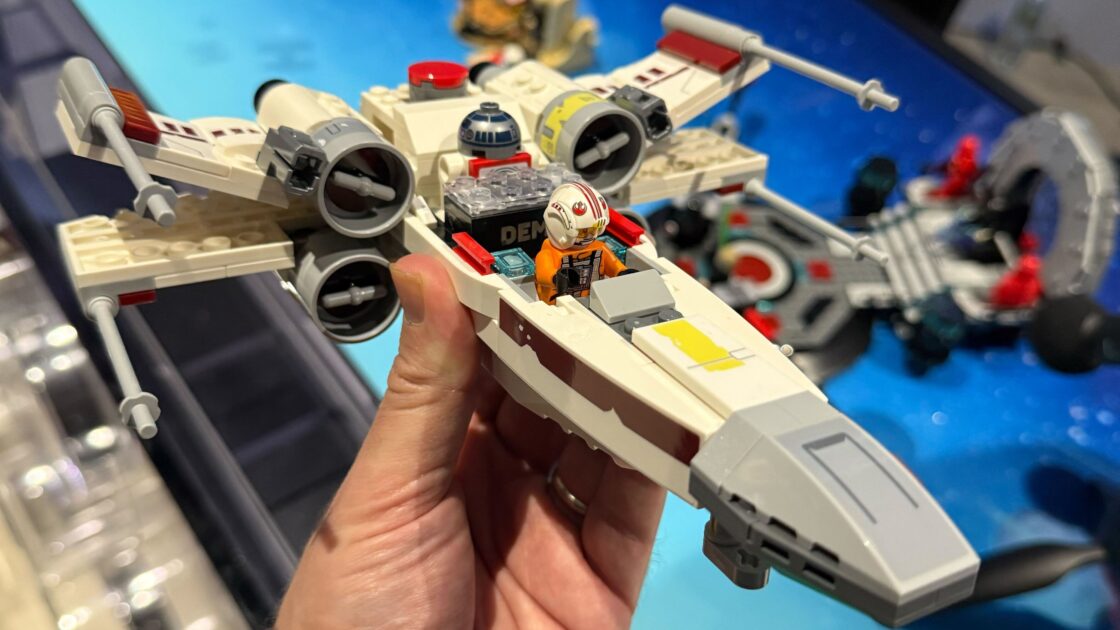
In hands-on demos, IGN was able to try out LEGO's upcoming Star Wars sets with Smart Play elements that will be used to launch the technology in March. These include an X-Wing set with a Smart Brick inside, which provides swooping engine noises as it detects the speed and direction of movement.
The Smart Brick itself is a sensor-packed 2×4 brick that is told to act as a certain thing by wirelessly connecting to Smart Tiles, tiny elements that essentially unlock a specific mode for the Brick to run. When told to be an X-Wing, the Smart Brick provides engine noises as it detects movement, illicits responses from a Smart Minifigure of Luke Skywalker or R2-D2 when seated in the cockpit, and can detect nearby weapons fire from a Smart Brick-infused TIE Fighter. The Smart Brick's ability to detect colors allows it to sense when other elements from the set are touched to it, such as a blue refuelling nozzle or green hammer, producing appropriate sounds.
Begher describes the development of Smart Play as iterative, with "pivoting" based on feedback from children and parents, but also learnings from previous LEGO projects such as its interactive Super Mario figures and Hidden Side range that featured extended play via an augmented reality smartphone app. From these, LEGO decided Smart Play needed to be fully physical and an integral part of LEGO's offering, "not something that's isolated and only exists in a corner of the portfolio."
"Something that we started to figure out with things like Super Mario," Begher continued, "[was] the fact that it shouldn't be too prescriptive, there needs to be play triggers. At the end of the day, kids need to play with it however they want and they want to goof around. We're not going to tell them, use the X-Wing this way or that way, it's your X-Wing.
"That was another learning — for instance, in Super Mario where some of the levels were very prescriptive. If you didn't make Super Mario do this, nothing would happen. And the fact that even if you don't want to use interactive technology, this has to be a great build and it has to have to be a great play experience. So it's a great Lego set, even if you take the Smart Brick and put it aside."
As for where Smart Bricks will develop in the future, Begher remaind tight-lipped, though suggested its current implementation in the company's first sets was just "the tip of iceberg", with the technology future proofed for more complex uses. "There's much more that this can do that will come eventually," Begher teased. "We've had to decide how big is the launch, and how big is the leap at launch? It needs to be a fantastic experience that's new and exciting, but it can be a leap so big that understanding, education becomes a hurdle, right? We worked on striking the right balance and the roadmap thinking of this."
Tom Phillips is IGN's News Editor. You can reach Tom at [email protected] or find him on Bluesky @tomphillipseg.bsky.social